
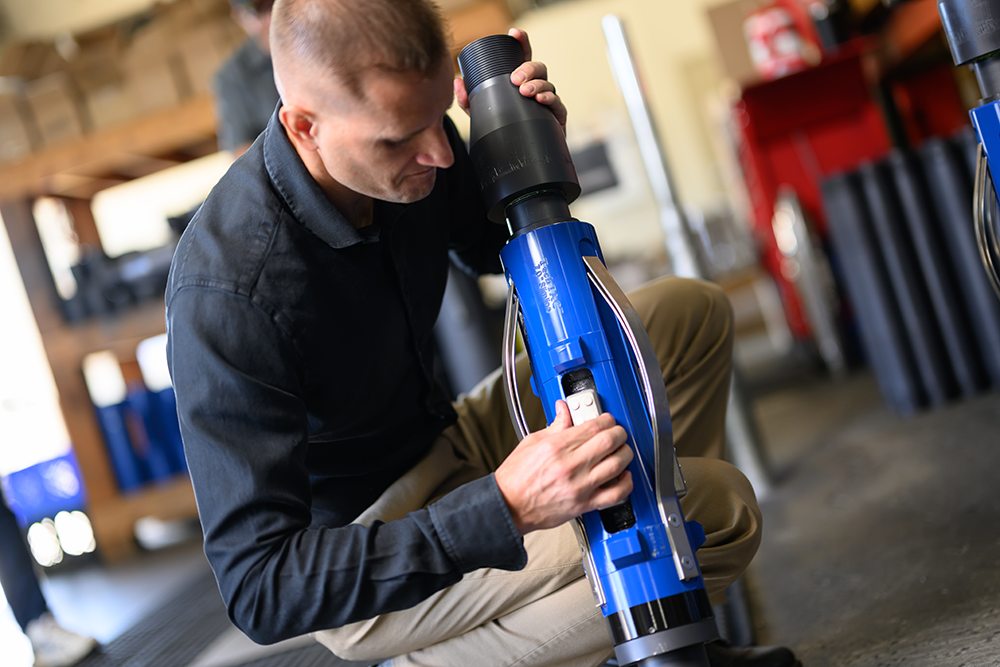
Anchoring a production tubing string can be especially challenging in deep or deviated wells. The distance and/or bend of the wellbore can make it difficult to get sufficient torque rotations down to the tool to fully set a traditional tubing anchor catcher (TAC). For these situations, TechTAC® created the Slimline® QuickSet™ TAC. The QuickSet™ anchor is designed to give engineers more flexibility when anchoring tubing strings in wellbores with extreme geometry. However, getting optimal value from the patent-pending Slimline® QuickSet™ TAC requires careful attention to some key best practices.

4 Key Considerations When Running a Quick-Setting TAC
- Use caution when running the anchor in and out. While this piece of advice sounds obvious, it’s especially important when working with the Slimline® QuickSet™. Because the QuickSet™ anchor can be set and released in 1-to-3 turns, as opposed to the traditional 6-to-8 turns, being cautious and deliberate about how the anchor is run in and out of a well is even more important than with a traditional TAC.
- Put a right-hand turn in the tubing occasionally. To prevent the tool from setting while running in, it is advisable to occasionally (about every 5-to-10 stands) put a right-hand turn in the tubing. Doing so will help prevent the anchor from setting prematurely. (If you are running a right-hand set TAC, put a left-hand turn in the tubing.)
- Use a pipe wrench instead of power tongs. When adding that right-hand turn every 5-to-10 stands, it’s important to use a pipe wrench instead of power tongs. The pipe wrench will allow you to feel when the tool is fully released and avoid damaging it. If you use power tongs, you could over-release the tool and shear the pipe plug. In turn, the anchor could bind up and fail. If there are times when it isn’t feasible to use a pipe wrench to add the right-hand turn – such as in very deviated or deep wells – the power tongs should be set to slow speed.
- Slow down. Especially when going through a tight spot in the well or when hitting fluid, it’s essential to take a slow, deliberate approach to running, placing, and setting the anchor.
A Powerful Combination for Deep or Deviated Wells
The Slimline® QuickSet™ TAC offers a flexible solution for anchoring production tubing strings in deep or deviated wells. Compared to the original Slimline® or a standard TAC, the QuickSet™ requires fewer string rotations to fully set the anchor. Yet it retains the patented Slimline® design, which increases flow-by capacity in the annulus by as much as 245%. That combination has helped the Slimline® QuickSet™ TAC support a wide range of deployments.

One engineer with a large energy company operating in the Permian described the anchor’s impact this way: “Despite trying a variety of different products, we could not get a tubing anchor to set in the dogleg of one of our horizontal wells. We tried standard and quarter-turn anchors but kept getting the same result. Finally, after hearing about the Slimline QuickSet TAC, we decided to give it a try – and we were able to fully set the anchor in the bend of the well.”
For more information about the Slimline® QuickSet™ TAC, download the product brochure or visit the QuickSet™ product page.


