

Petroleum engineers well understand the value of including a tubing anchor catcher (TAC) in deep-well downhole production strings. With relatively shallow wells of 5,000 feet or less, however, the consensus is not as universal.
Sometimes operators will leave shallow wells unanchored to maximize profit margins. The rationale is that the additional cost of adding a TAC would outweigh any resulting gains in productivity. But research tells a different story.
Unanchored Tubing in Shallow Wells
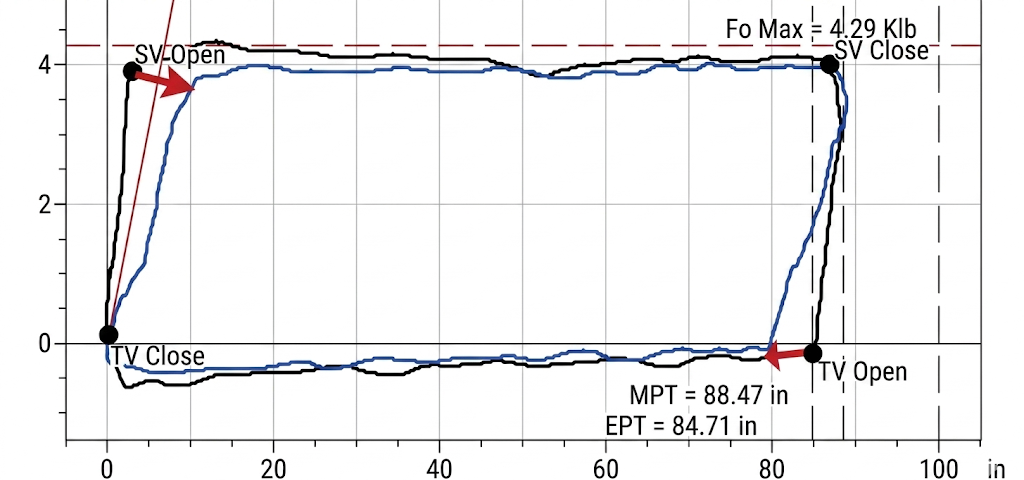
A recent report1 from collaborators at Echometer Company and Midwestern State University compared the dynamometer card data of the same well when the tubing was unanchored and then anchored. The engineering team set the rod pump at a depth of 5,226 feet in both scenarios. Figure 1 highlights the results. The blue line shows the pump performance with unanchored tubing, while the black line does the same for the anchored tubing.
| Unanchored Tubing | Anchored Tubing | |
| Maximum Plunger Travel | 88.97 in | 88.47 in |
| Effective Plunger Travel | 79.69 in | 84.71 in |
Analyzing the Results
In both scenarios, the Maximum Plunger Travel (MPT) is roughly the same. However, the Effective Plunger Travel (EPT) is 6% less with the unanchored tubing. In other words, without a TAC stabilizing the well tubing, the rod pump plunger loses 5.02 inches of travel.
An EFT that’s reduced by 5 inches – less than the length of a U.S. dollar bill – may seem insignificant, but with a rod pump making thousands of strokes each day, the impact can be substantial. AI analysis shows the projected impact by various pump sizes:
| Pump Plunger Diameter | Unanchored (BPD) | Anchored (BPD) | Daily Increase (BPD) |
| 1.25″ (Small) | 152.0 | 161.2 | +9.1 |
| 1.50″ (Common) | 218.9 | 232.1 | +13.2 |
| 1.75″ (Common) | 298.0 | 315.9 | +17.9 |
| 2.00″ (Large) | 389.2 | 412.6 | +23.4 |
| 2.25″ (Heavy Duty) | 492.6 | 522.2 | +29.6 |
For a common 1.75-inch pump plunger, recovering that lost stroke distance yields an extra 17.9 barrels of fluid per day. At an assumed price of $70 per barrel of crude, that bumps the recovered value up to roughly $1,250 per day in additional potential revenue!
With that efficiency improvement, operators would recover the cost of even the most expensive tubing anchors in under a week.
Negative Effects at Virtually Any Depth
The financial impact of anchoring the relatively shallow well noted above is substantial. What’s more, that impact grows exponentially as wells get deeper. Figure 2 below, taken from a 2011 report2 from SPE and Odessa Separator, shows the increasing impact pump depth has on tubing stretch.
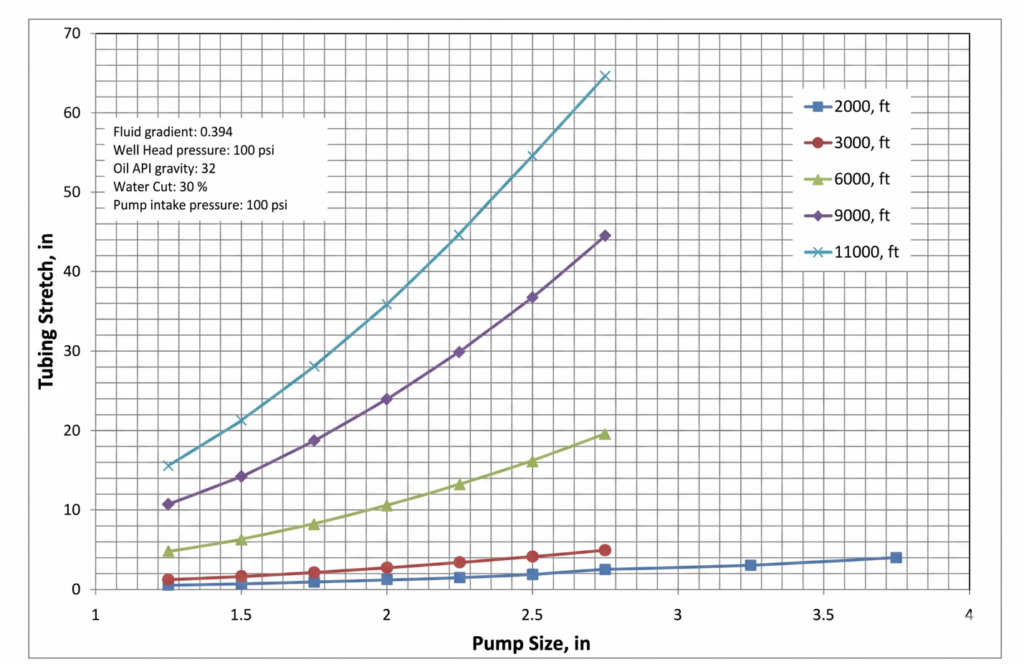
With greater tubing stretch comes lower pump performance – and less revenue. At 6,000 feet and deeper the tubing stretch rises dramatically, reducing the distance the rod pump travels on each stroke. However, even in the shallow wells of 2,000 and 3,000 feet, efficiency and production will be impacted by unanchored tubing.
The Slimline TAC in Shallow Wells
With traditional B2-style TACs, the benefits gained from securing a well’s tubing must be balanced against the negative effects of the anchor itself. A traditional TAC essentially creates a “choke point” within a well, because the annular space between the anchor OD and the casing ID is so small. In turn, that choke point can create a pressure drop that leads to the formation of scale, iron sulfide and paraffin. When those minerals are present, plugging is often the result. Plugging occurs when sediment bridges off on top of the anchor and effectively cements it in place. No fluid can fall past the anchor, and no gas can flow up.
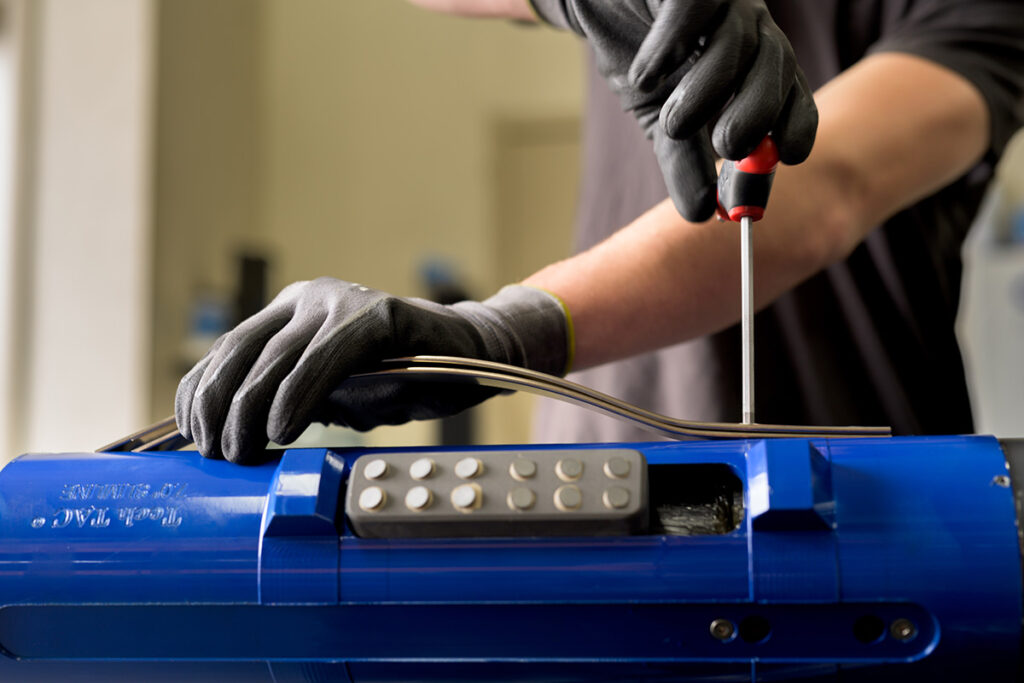
The Slimline® TAC – and variations like the Slimline® Full Bore TAC and Slimline® QuickSet™ TAC – mitigate these issues. The Slimline anchor’s reduced OD creates up to 245% more flow-by area than a standard B2 TAC. That increase allows the Slimline TAC to deliver the benefits of anchored tubing without creating additional challenges around scale formation and gas locking.
To learn more about the increased efficiency and production made possible by the Slimline TAC – even in shallow wells – contact the TechTAC team today or email info@techtac.com.
1 – How to Determine if Tubing is Unanchored in Rod Pump Wells by Analyzing Dynamometer Data; O. Lynn Rowlan, Gustavo Fernandez, and Carrie Anne Taylor, Echometer Company / Sheldon Wang, Ph.D.,P.E., McCoy School of Engineering, MSU Texas; 2023 Southwestern Petroleum Short Course
2 – Challenges in Selection and Design the Beam Pumped Well Completions; Mohamed Ghareeb Moustafa, SPE & Lufkin / Bob Greer, Odessa Separator; 2011 Middle East Drilling Technology Conference and Exhibition


