

When it comes to well completions, many considerations influence the final design of a production tool string. Sometimes the well conditions or geometry are a primary factor. Sometimes the above-ground equipment has a significant impact. In a few of those use cases, augmenting your tubing anchor catcher (TAC) with a heavy-duty mandrel may be an important addition.
Adding a Heavy-Duty Mandrel
One of the customization options available when purchasing a Slimline® TAC from TechTAC® is a heavy-duty, or HD, mandrel. The ID of the HD mandrel is reduced slightly to make the wall of the mandrel thicker and stronger. For example, the wall on an HD mandrel in a 7.0” Slimline is 0.2” thicker than a typical anchor body. That thickness results in an ID that’s reduced from 2.4” to 2.0”. Similarly, the ID of a 5.5” Slimline with an HD mandrel is reduced from 2.0” to 1.75” so the thickness of the body wall can be increased by 0.125”.
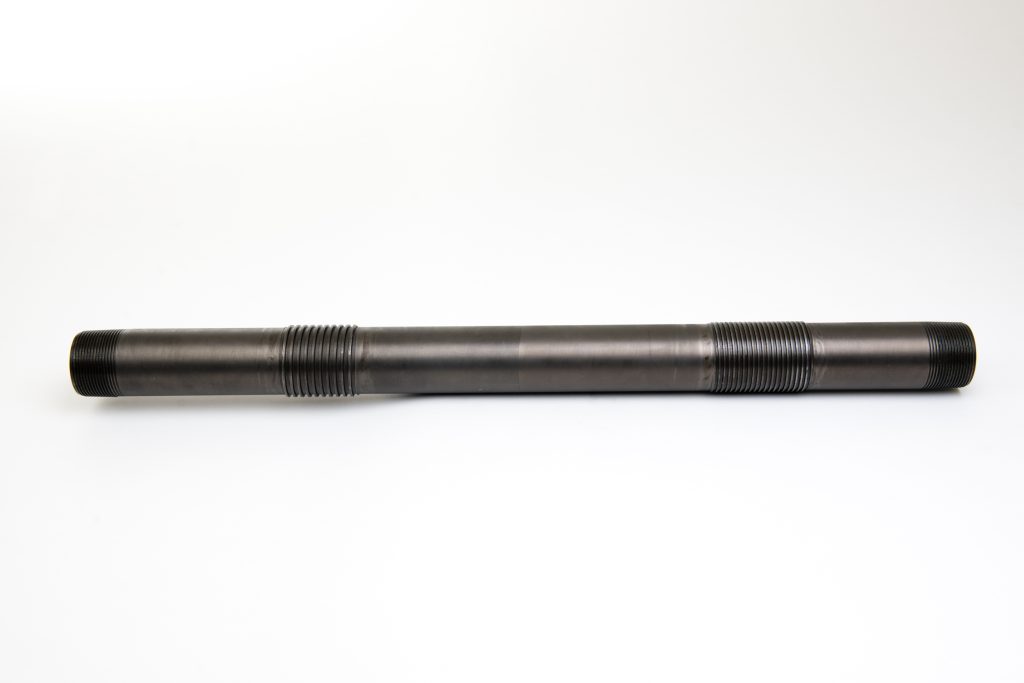
Use Cases for the HD Mandrel
The additional thickness of the wall of an HD mandrel adds strength to the body. That increased strength may be a valuable addition to several use cases:
- Placing the TAC below the seat nipple. The Slimline TAC can be safely run below the seat nipple. The anchor’s increased flow-by area makes it far less susceptible to the scale formation, sediment buildup and gas interference than a standard B2 TAC in the same position. However, placing the anchor below the seat nipple can also increase the stress on the TAC itself. The increased dynamic forces from pumping and other factors can put additional strain on the anchor. That’s why TechTAC recommends operators use an HD mandrel whenever a 5.5″ Slimline TAC is set below the seat nipple.
- Placing the TAC in the curve of a horizontal well. Slimline TACs can – and have – been successfully deployed below the kickoff point of a horizontal well. However, doing so may expose the tool to increased side loading and stress. If you determine that placement is appropriate, an HD mandrel can provide extra protection.
- When there’s an increased risk of breakage. Using a TAC with an HD mandrel significantly diminishes the risk of breaking the body because of over-torquing the top sub. Sometimes an inexperienced rig crew or a particularly challenging well (deep, deviated, etc.) can lead to over-torquing the connection between the top sub and the body. The resulting stress could lead to a break. An HD mandrel can mitigate the risk of such an accident.
These use cases may benefit from the use of an HD mandrel. The decision of how and where to deploy a TAC is ultimately up to the operator.
What’s the Downside?
The only potential downside to choosing an HD mandrel is the reduction in the anchor’s ID. Some operators prefer to set the anchor above the seat nipple and run the rod pump through it. That design may require a larger ID. As noted above, the Slimline TAC can be safely run below the seat nipple. However, if the operator prefers to run an anchor above the seat nipple with a pump running through it, a standard mandrel may be the better option.
To learn more about the Slimline TAC – or the patented Slimline® QuickSet™ TAC, which offers all the benefits of the original Slimline anchor while fully setting in just 1-3 turns – check out the anchor product pages or contact the TechTAC team today!


