

Petroleum engineers have several strategies they can employ to try to improve the efficiency of a sucker rod pump. Some of those strategies require expensive workovers. Others entail tool string adjustments. However, operators often overlook one relatively inexpensive change that can significantly impact production and operating costs. This article highlights that frequently neglected option.
Common Challenges with a Sucker Rod Pump
Three issues that frequently hinder the producing power of a sucker rod pump are gas, sand and scale. What’s more, a well’s tubing anchor often contributes to each of those issues.
- Gas Locking – When a sucker rod pump gas locks, the area in the pump barrel below the plunger contains mainly gas – and gas is compressible, where fluid is not. Therefore, on the downstroke, all that happens within the pump is gas compression and expansion. One of the main contributors to gas locking is the small annular area between the ID of the well casing and the OD of a standard B2 tubing anchor catcher, or TAC. This small annular space creates a chokepoint that traps gas below it. Eventually, that gas will build up and gas lock the sucker rod pump.
- Sand Bridging – While formation gas is accumulating below the TAC, sand and sediment can be building up on top of it. Over time, that sediment plugs the small annular space at the top of the TAC. The result is a stuck anchor – often requiring an expensive fishing job – and an even greater barrier to gas flow.
- Scale Formation – A recent CFD study found that the small annular area around a standard B2 TAC also creates a significant pressure drop as fluid moves across it. That pressure drop contributes to the formation of scale, iron sulfide and paraffin. In turn, those minerals can slow production and limit the effectiveness of a sucker rod pump.
Change the TAC to Optimize a Sucker Rod Pump
Deploying slim-style tubing anchors instead of standard B2 TACs can help mitigate those issues. The Slimline tubing anchor, for example, features a reduced OD that offers up to 245% more flow-by area around the anchor than a standard B2 TAC. That increase allows gas to flow up the annulus and sediment to drop down past the anchor without creating a choke point that restricts flow and leads to the formation of scale, paraffin and other deposits. In other words, simply switching the kind of TAC used with a sucker rod pump can help reduce – or in some cases even eliminate – gas locking, sand bridging and scale formation.

Validated by CFD Analysis
A recent computational fluid dynamics (CFD) study validated the Slimline TAC’s ability to increase the production and efficiency in wells that use a sucker rod pump. The independent consulting firm Imaginationeering provided “a comparison CFD analysis of a gas flow within the annular space around two types of a 5.5-inch tubing anchor catcher to assess the differences between them in terms of flow parameters.” Specifically, the analysis compared a standard B2 TAC and a Slimline TAC relative to fluid velocity, pressure drop, turbulence, vorticity and other factors.
The analysis found that the net pressure drop around a standard B2 TAC, as fluid/gas passes through the annular cavity around the anchor, is more than double the pressure drop around the Slimline TAC. It also highlighted the Slimline tubing anchor’s noticeable advantage over the standard B2 anchor in reducing the turbulence and vorticity strengths within the flow field.
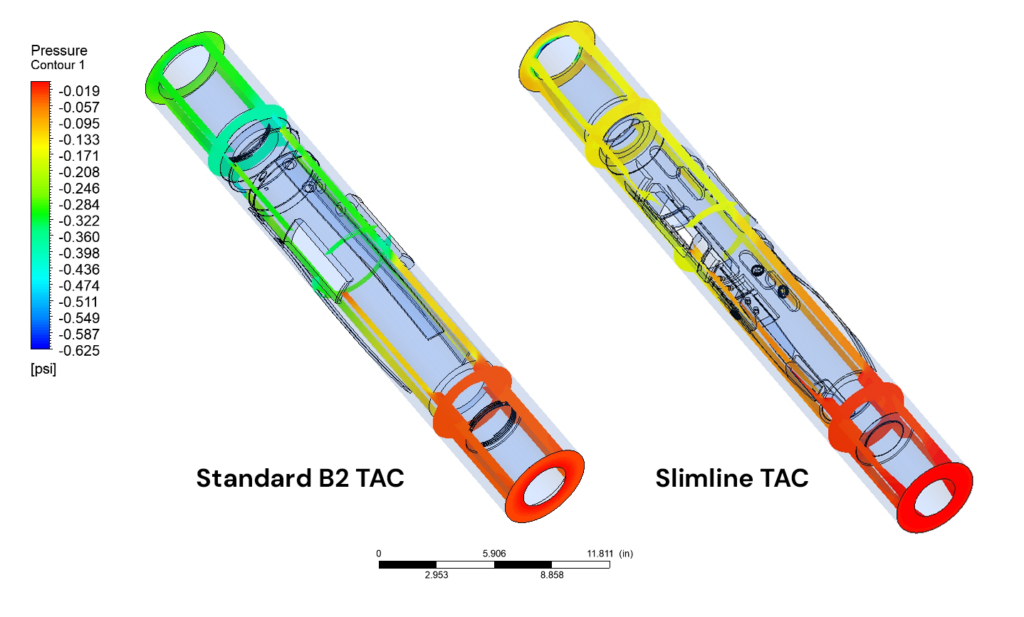
In other words, the significant pressure drop and increased turbulence around the standard B2 TAC can have a material impact on sucker rod pump performance. Those parameters are major contributors in the formation of scale, iron sulfide and paraffin, and they play a role in the advent of gas locking.
Customers Use the Slimline TAC to Improve Sucker Rod Pump Performance
Below are comments from real TechTAC customers who have replaced standard B2 TACs with Slimline anchors to optimize the performance of a sucker rod pump:
Reducing the Impact of Sand and Scale
“We have one well that had to be pulled every 3 months due to scale. After installing a Slimline TAC, we didn’t need to pull it for 2 years.”
>> Sr. completion foreman with a U.S.-based oil and gas company
“We were having problems getting standard anchors to both set and release due to sand and scale. With the increased annular area the Slimline provides, sand was able to fall past the anchor instead of accumulating on top of it. Both sand and scale bridging issues were dramatically reduced.”
>> Rig operator with a large U.S.-based oil and gas company

Mitigating the Effects of Formation Gas
“[Slimline anchors] work well for gas interference issues in our wells with 5.5-inch casing. We’ve seen a 25- to 30-percent increase in the volume of gas being discharged on the surface.”
>> Production superintendent with an independent E&P company operating in the DJ Basin
“We had one well that had a 500,000 cubic feet of gas increase per day just by switching to a Slimline anchor.”
>> Sr. completion foreman with a U.S.-based oil and gas company
Increasing Production
“Wells do produce higher rates with a Slimline tubing anchor, so we want to run them where we can get them set without backing off tubing.”
>> Engineer with a large U.S.-based energy company
“All three wells [we switched to the Slimline TAC] went from producing roughly 40 barrels per day to approximately 80 barrels per day – a 100 percent increase.”
>> Production superintendent with an independent E&P company operating in the DJ Basin
Minimizing the Risk of Stuck Anchors
“We used to budget every year for 1 in 20 of the tubing anchors we ran to get stuck and need to be cut over. Since switching to the Slimline TAC, our number of stuck anchors has decreased dramatically.”
>> Engineer at a mid-sized production company operating in the Permian
“One of our oilfield customers ran four standard anchors down the same well, and each time the anchor would get stuck and then shear. When they finally tried a Slimline, the anchor set right away and has worked well ever since.”
>> Manager at an oilfield supply company in the Southern United States
Conclusion
For more than two decades, operators have used the Slimline TAC to improve the efficiency and effectiveness of wells with sucker rod pumps. Bruce Friesen, a petroleum engineer and former global artificial lift advisor for BP, had this to say about TechTAC’s innovative products: “[There are] multiple benefits of running the TechTAC Slimline anchor. Number one, reduce pressure and temperature drop, reduce turbidity and turbulence, which all four of those things contribute and cause the formation of scale, iron sulfide, paraffin and solids. [Eliminate] all those parameters … then you don’t have plugging. You don’t have stuck anchors. You don’t have fishing jobs. And you also don’t have what is one of the biggest issues and problems and headaches in the oil patch is gas locking of your rod pump.”
To learn more about the Slimline TAC, including technical specifications, sizes and authorized dealers, download the Engineering Info Packet or Request a Quote.


