

Production engineers understand that downhole stability is critical for efficient artificial lift operations. When selecting tools to secure a production string, a common point of clarification emerges. Not all tubing anchors are created equal, and specifically, not all tubing anchors function as tubing anchor catchers (TACs).
For example, standard quarter-turn tension anchors are designed primarily to maintain tension on the tubing string to reduce buckling. However, they typically lack dual-directional locking mechanisms. Similarly, standard hydraulic tubing anchors utilize internal pressure to expand slips against the casing wall. Yet most models do not provide an independent mechanical failsafe.
Why Production Engineers Prefer ‘Catcher’ Functionality
Production engineers generally prefer the explicit “catcher” functionality found in a true TAC. A tubing anchor catcher holds the tubing string in both tension and compression. More importantly, it acts as an indispensable safety device. If the tubing string parts or breaks above the tool, the catcher mechanism prevents pipe from falling down the well. This functionality can save operators from catastrophic well damage and costly fishing jobs.

The Evolution from Baker B2 to Slim-Style TACs
For decades, the standard Baker B2-style TAC has been a staple of the oil and gas industry. Deployed in tens of thousands of wells globally, the B2-style anchor earned its reputation through mechanical simplicity and slip engagement. However, traditional B2 anchors carry a major inherent drawback: their outside diameter (OD) is nearly as large as the inside diameter of the well casing. This tight fit creates a severe annular restriction downhole, effectively acting as a choke point for fluid and gas trying to migrate to the surface.
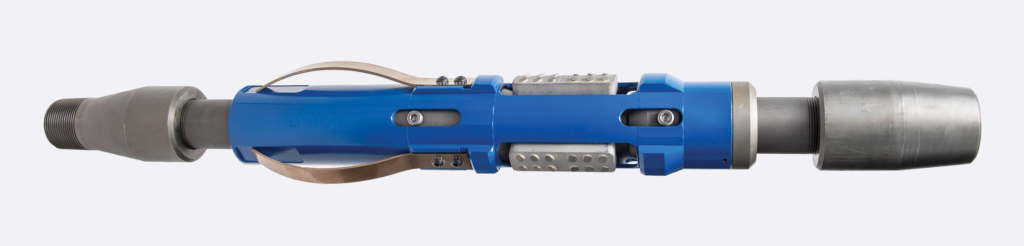
To overcome these traditional restrictions, modern production engineers are increasingly choosing slim-style TACs. In this category, the patented Slimline® TAC from TechTAC® has emerged as the definitive market leader. By re-engineering the internal and external geometry of the tool, slim-style designs offer a reduced OD while maintaining full mechanical integrity and the essential catcher functionality that many production engineers require.
What the Science Says: Flow-By Area and CFD Research
The operational benefits of adopting the Slimline TAC are firmly supported by rigorous scientific research. An independent computational fluid dynamics (CFD) study revealed several fluid-dynamic penalties with traditional anchor designs. In particular, the research demonstrated that the net pressure drop around a standard Baker B2-style anchor is more than double the pressure drop experienced around the Slimline TAC.
In physics and petroleum engineering, a steep pressure drop across a narrow restriction can trigger severe operational consequences. It accelerates the precipitation of scale, iron sulfide, and paraffin out of the wellbore fluid, which can rapidly accumulate and bridge off on top of the anchor, potentially cementing it in place. In addition, formation gas can be trapped below the TAC, eventually leading to a gas locked sucker rod pump.
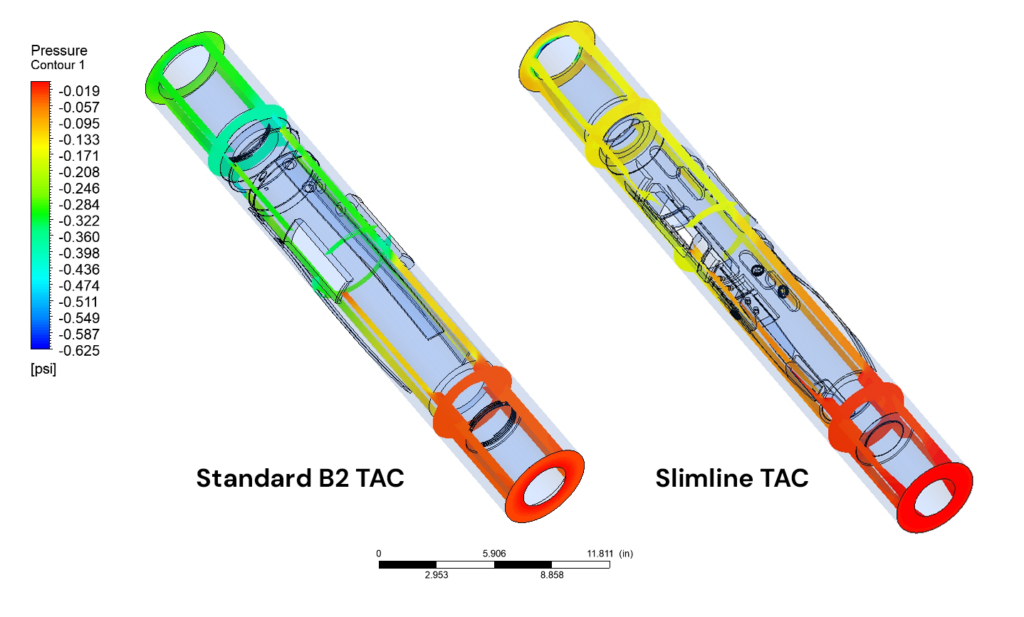
By providing up to 245% more flow-by area in the well’s annulus, the Slimline TAC eliminates this chokepoint. The CFD study also confirmed a noticeable reduction in overall turbulence and vorticity strengths within the flow field around the Slimline anchor, yielding a smoother, more laminar flow. According to field data compiled alongside this research, operators frequently report a 15% to 25% increase in pump fillage after switching to a slim-style anchor, translating directly to higher production rates, lower lifting costs, and significantly extended runtimes between workovers.
To learn more about TechTAC’s suite of Slimline tubing anchor catchers and why they are often the preferred downhole tool of production engineers, check out the Slimline TAC Engineering Info Packet or contact the TechTAC team.


