

The Slimline® TAC has lowered lifting costs and improved production for thousands of wells across North America and beyond. Those benefits are largely the result of the Slimline anchor’s increased flow-by area when compared to a standard B2 TAC. But what does that increase actually look like? Sometimes it can be difficult to visualize.
Thankfully, one of TechTAC’s Authorized Dealers created an ingenious physical model to demonstrate it. Vannevar is an oil tools supplier specializing in innovative solutions that optimize well production and reduce costs. The company leverages the Slimline Tubing Anchor Catcher in some of its offerings. To demonstrate the improved flow-by capacity of these solutions, the team at Vannevar created a clever scale model of two types of tubing anchors. In both cases, the model TACs were housed in fluid and air was pumped in below them. The air simulated the effects of gas interference in a well. A bright light was also mounted at the top of each model to highlight the differences in flow-by capacity.
Worth a Thousand Words
Below is a photo of the model. On the left is a replica of the Slimline tubing anchor, with its reduced OD. On the right is a standard B2 TAC. Because the OD of the standard anchor is nearly as large as the model’s “casing,” the photo shows the TAC acting as a choke, trapping the gas below anchor. When enough formation gas is trapped below the tubing anchor catcher, gas locking of the rod pump can result.
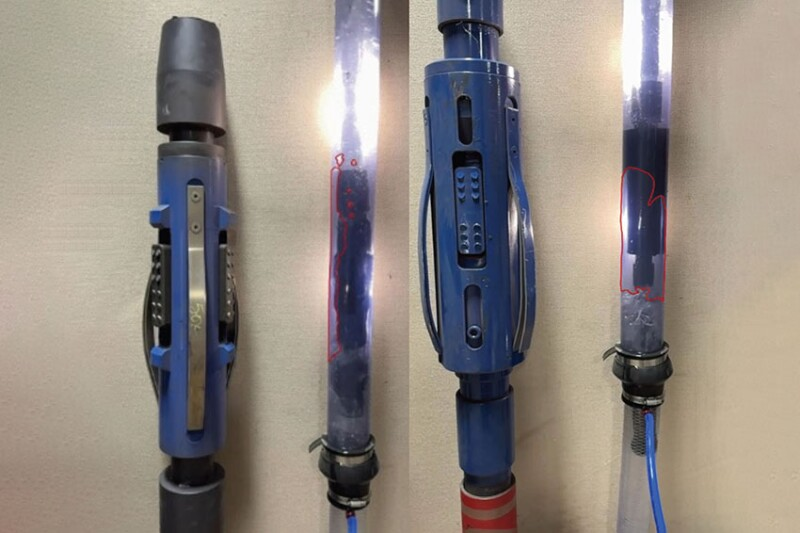
The Slimline TAC model on the left is different. It shows how the anchor’s increased flow-by capacity allows formation gas to flow around the TAC instead of getting trapped below it. This ability to mitigate the impact of formation gas has made the Slimline TAC a key component of many downhole assemblies.
Success with the Slimline TAC‘s Increased Flow-by Area
One major U.S. oil and gas producer was struggling with high fluid levels in several wells. The operator discovered that the fluid could not sufficiently drop past a standard anchor. According to a senior completion foreman with the firm, “Those elevated levels were causing some pump failure due to gas locking.” And of course, with pump failure comes expensive workovers and downtime.
To address the problem, the producer decided to evaluate the Slimline TAC. The results were significant and immediate. “We tried the Slimline TAC,” the foreman said, “and in every well we tested, fluid levels were at or just above the anchor.”
Another E&P company found similar success dealing with formation gas. This independent producer operates many mature wells in the DJ Basin. Gas interference is a common challenge. The group ran the new Slimline Full Bore TAC in three of these mature wells and saw a direct impact on gas discharge. “We have had good luck with the Slimline Full Bore TAC so far,” a production superintendent with the firm said. “They are very easy to set and release, [and] they work well for gas interference issues in our wells with 5.5-inch casing. We’ve seen a 25- to 30-percent increase in the volume of gas being discharged on the surface.”
To learn more about the benefits of the Slimline TAC in mitigating gas interference, contact the TechTAC team today and check out this blog post! To talk to the team at Vannevar about their oilfield solutions, visit www.vnvr.us.


