

Sometimes small changes can have a big impact. Like intermittent windshield wipers or QR codes, seemingly small innovations can have a significant effect on the productivity and safety of an operation. In the oilfield, the tubing anchor catcher can be one of those small changes. This article will highlight the surprising ROI of the Slimline® TAC from TechTAC® when operators choose to run it instead of a standard B2 tubing anchor catcher.
The calculations below are based on actual customer experiences. However, we understand that every well is different, and many factors determine the effectiveness of a downhole tool string. Still, the data below can help illustrate, in basic terms, the positive financial impact that can result from replacing a B2 anchor with the Slimline TAC.
The Scenario
Although the Slimline TAC has been shown to improve well productivity (more on that below), this return on investment (ROI) calculation is based solely on reducing the downtime that results from common problems associated with B2 TACs. Following are the parameters used for this sample scenario:
- Number of wells – 100
- Average number of barrels per day per well – 28
- Number of wells you have to pull prematurely each year because of a stuck anchor (e.g., scale, sand, etc.) – 4
- Number of wells that become gas locked each year – 20
- Price of crude per barrel – $72
Workover Costs
Another important element in determining the ROI of the Slimline TAC is the cost of workovers. Whether changing out the rod pump or fishing a stuck anchor, workovers are typically required to remedy the production issues noted above. For the purposes of this example, the following schedules and costs will be used:
- Average number of days for a complex workover to fish a stuck anchor and replace the rod pump – 5
- Average number of days for a workover rig to change out a sucker-rod pump (SRP) to minimize gas locking – 3
- Average cost per day for a complex workover to fish a stuck anchor – $7,500
- Average cost per day for a workover rig to change out an SRP – $5,700
Calculating the Impact
The small annular area around a standard B2 TAC has been linked to many downhole issues. In the example above, four of 100 wells require a fishing job to retrieve a stuck anchor each year. Of those same 100 wells, 20 will become gas locked. The impact of the resulting downtime can be calculated based on both production losses and workover costs. The cumulative effect is a potential one-year financial impact of:
- Production losses due to downtime (bbls/yr) – 1,680
- Production losses due to downtime – $120,960
- Workover costs related to stuck anchors – $150,000
- Workover costs related to gas locking – $342,000
- TOTAL IMPACT – $612,960
It should be noted that the production losses outlined above have been reduced by a factor of 0.75. This reduction is to account for flush production once the wells begin pumping again.
The Benefits and ROI of the Slimline TAC
Next, we’ll highlight some of the benefits TechTAC customers have realized by switching from standard B2 TACs to Slimline tubing anchors. Obviously, these benefits may not apply to every well in every situation. However, they are based on multiple real-world customer experiences. In each case, the percentages that follow the benefit statements are the actual impact we’ll use in our ROI calculation, since we want to use a conservative estimate of the resulting benefits.
- The Slimline TAC can reduce the number of stuck anchors by as much as 87%. The anchor’s reduced OD and tapered design prevents sediment from bridging on top of the TAC. For the ROI calculation, we’ll assume a 50% reduction in stuck anchors.
- The Slimline TAC can eliminate up to 80% of all instances of gas locking. The anchor’s reduced OD creates up to 245% more flow-by area, so formation gas doesn’t get trapped below the TAC. Once again, we’ll use the more conservative estimate of a 50% reduction in instances of gas locking.
- The Slimline TAC can reduce anchor cutover time by as much as 50% because only the slips and slip protectors need to be cut. We’ll estimate a time savings of 33%.
Incremental Costs and Return on Investment
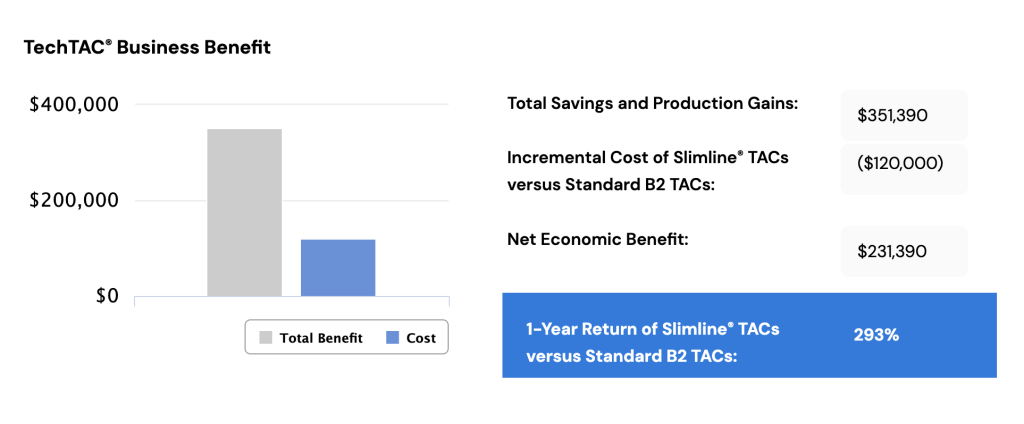
Replacing all the B2 tubing anchors in 100 wells with Slimline TACs would create an incremental cost of just over $100,000 based on average dealer pricing. At the same time, because of the Slimline TAC’s proven ability to help mitigate gas locking and stuck anchors and reduce downtime, that switch would lower the financial impact (resulting from lost production, workover costs, etc.) of those problems from $612,960 to $261,570. Factoring in the incremental cost of the Slimline TAC, that’s a net savings of $231,390! Said differently, the first-year ROI of switching to the Slimline TAC is 293%!
Potential Production Increases
As noted previously, this conservative ROI calculation is based solely on a reduction of downtime related to common challenges often attributed to the “choke point” created by a standard B2 TAC. However, it’s important to highlight that TechTAC customers have also experienced notable production increases by switching to a Slimline tubing anchor.
One such customer is a superintendent with an independent production company. He said, “We have seen increased pump fillage on wells we converted to the Slimline TAC. Increases of 15-to-25 percent are common. The typical wells we have installed the Slimline anchors in are horizontal wells with an average total fluid rate of 20-to-25 bbls per day. We have increased the majority of these to 35-to-40 bbls per day due to increased pump fillage and runtimes.”
A similar sentiment was expressed by an engineer with a Fortune 500 energy company, who said, “Wells do produce higher rates with a Slimline tubing anchor, so we want to run them where[ver] we can get them set….”
In these and many other cases, well production was enhanced thanks to the increased flow-by area created by the Slimline TAC.
Exploring the ROI of the Slimline TAC for Your Operations
Despite the compelling case in the example above, don’t take our word for it. TechTAC offers a variety of resources to help you determine if the Slimline TAC could deliver a strong ROI for your organization:
- Use our ROI Calculator to adjust the scenario parameters to match your operation.
- Download this Computational Fluid Dynamics Report, which compares the standard B2 and Slimline TACs across several flow parameters.
- Access the Society of Petroleum Engineers Tech Talk “Strategies for Eliminating Gas Locking in Rod Pump Systems,” sponsored by TechTAC.
Ultimately, the value of any artificial lift system and associated equipment is dependent – at least in part – on the unique conditions of an individual well. The data in this example is not intended to be a precise evaluation of all the factors that could impact production and downtime. Instead, it shines a light on the areas of improvement a well could experience by making one simple change to the downhole tool string. For more information about the Slimline TAC, call 435-781-1675, email info@techtac.com or visit techtac.com/contact.


